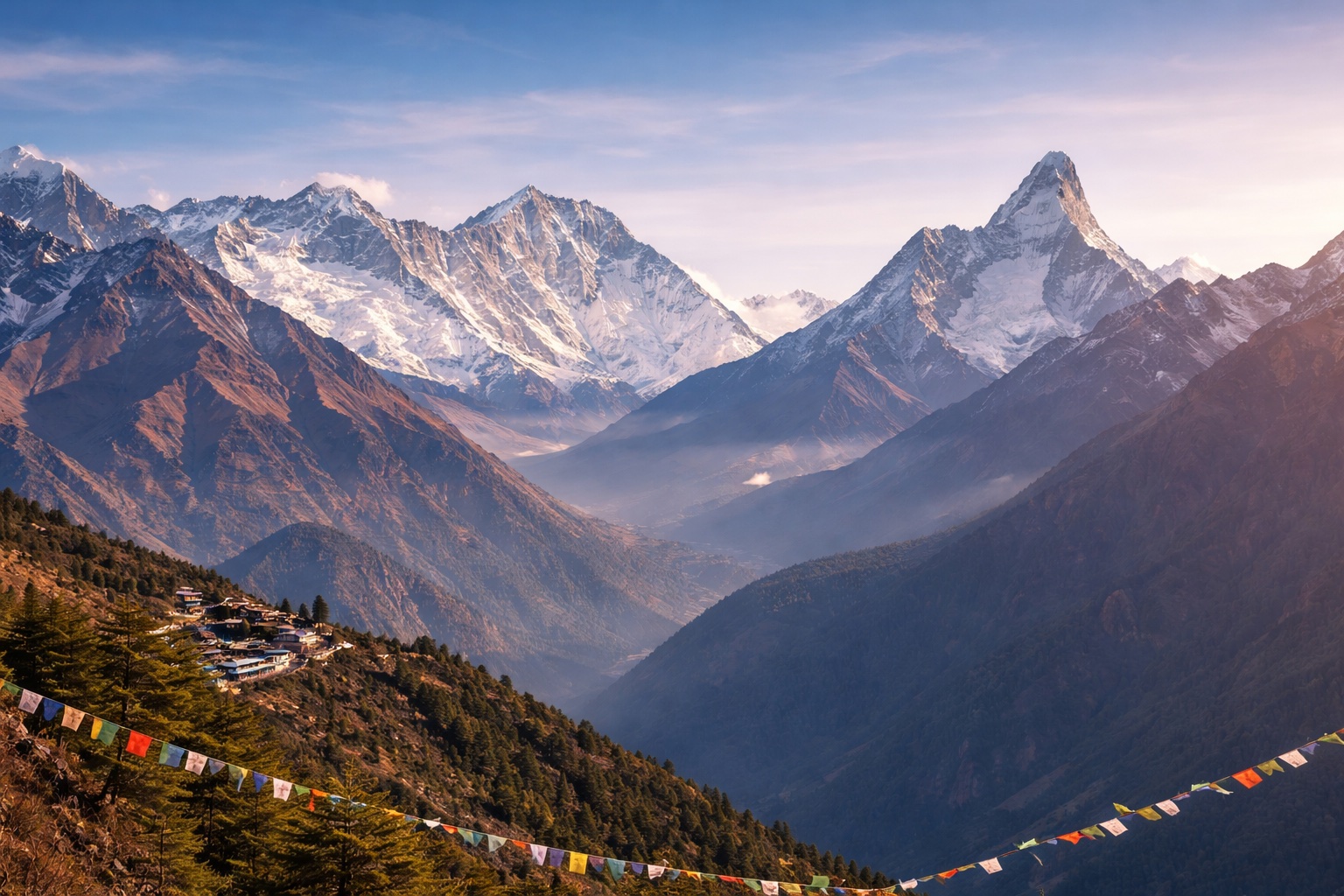
The Annapurna Circuit trek is a 14-day guided trek around the Annapurna massif, one of the great long-distance walks of the world. Climb the Marsyangdi valley through forest, Gurung and Tibetan-influenced villages to Manang (3,540 m), cross the Thorong La pass (5,416 m), one of the highest trekking passes on Earth, and descend to the pilgrimage temple of Muktinath and the desert landscapes of the Kali Gandaki valley.
This itinerary follows quieter footpaths away from the road where possible, includes an acclimatisation day in Manang and ends with a scenic flight from Jomsom to Pokhara. The trek is strenuous, with a long pass day, and is best from March–May and October–November. A licensed guide, porters, permits, transport, the Jomsom flight, hotels and teahouse lodges with meals are all arranged by our team in Kathmandu.
The Annapurna Circuit has been famous since Nepal opened to trekkers, and it is still one of the most varied treks anywhere. In two weeks you walk from rice terraces and subtropical forest into pine woods, Tibetan-style villages, high alpine valleys and finally the arid, wind-swept landscapes of the upper Kali Gandaki. Along the way you see Annapurna II, III and IV, Gangapurna, Tilicho Peak and, across the valley, Dhaulagiri (8,167 m).
The highlight is the crossing of the Thorong La at 5,416 metres, a high pass marked by prayer flags between Manang and Muktinath. Roads now reach parts of the circuit, but good itineraries use the old footpaths on the other side of the valley and drive the lower sections, so you spend your walking days where the scenery is best.
| Trip fact | Details |
|---|---|
| Duration | 14 days from Kathmandu (8 days of trekking) |
| Highest point | Thorong La pass, 5,416 m (17,769 ft) |
| Grade | Strenuous |
| Daily walking | 5–7 hours; 8–10 hours on the pass day |
| Start and finish | Kathmandu, with a drive to Dharapani and a flight Jomsom – Pokhara |
| Accommodation | Hotels in Kathmandu and Pokhara, teahouse lodges on the trek |
| Permits | Annapurna Conservation Area Permit (ACAP) |
| Best time | March–May and October–November |
The trek starts with a long drive from Kathmandu to Besisahar and up the Marsyangdi valley by jeep to Dharapani. From here you walk through forest to Chame, past the great curved rock face of Paungda Danda, and on to Upper Pisang, with views of Annapurna II. The high route via Ghyaru and Ngawal is one of the most beautiful sections of the circuit, with balcony views of the Annapurnas, before you descend to Manang.
After an acclimatisation day in Manang, the trail climbs to Yak Kharka and Thorong Phedi. On the pass day you start before dawn, climb over 900 metres to the Thorong La, and descend about 1,600 metres to Muktinath. The following day you drive past Kagbeni to Jomsom, and fly to Pokhara the next morning.
The circuit is graded strenuous. Most days are moderate, but the pass day is long and hard: an early start, a steady climb in thin air to 5,416 m, and a steep, knee-testing descent. Snow can make the pass harder, especially in winter and early spring. No climbing skills are needed, but good fitness, previous hiking experience and careful acclimatisation are important.
The itinerary gains height gradually and includes a rest day in Manang (3,540 m), where you can hike to the Gangapurna glacier lake, the Ice Lake viewpoint or Praken Gompa, returning to sleep in Manang. Nights at Yak Kharka and Thorong Phedi continue the gradual ascent. Your guide monitors every trekker, and if anyone is unwell before the pass, the group waits or the trekker descends. The circuit is walked anticlockwise, from Manang to Muktinath, because this direction allows safer acclimatisation.
October and November are the most reliable months for crossing the pass, with clear skies and stable weather. March to May is also excellent, although early March can bring snow on the pass. In winter the Thorong La is often closed by snow. During the monsoon, the lower valley is wet, but the upper circuit beyond Manang lies in a rain shadow and stays much drier.
The circuit has a dense network of teahouses. Lower lodges often have attached bathrooms and hot showers; at Thorong Phedi and High Camp, rooms are basic. The Thakali villages of the Kali Gandaki, such as Marpha, are famous for dal bhat and apple products, and Manang has bakeries serving cinnamon rolls and apple pie.
The trek requires the Annapurna Conservation Area Permit (ACAP), checked at Chame, Manang and other posts. It is included and arranged by our team, together with a licensed guide as required by Nepal's trekking rules.
With two or three extra days, you can visit Tilicho Lake, one of the highest large lakes in the world at about 4,919 m, from Manang. From Kagbeni, the restricted region of Upper Mustang stretches north towards Tibet. Ask us about adding either to your circuit.
You should be comfortable walking 5–7 hours a day for many days in a row, and prepared for one very long day of 8–10 hours at high altitude. Train for two to three months with long hill walks, ideally on consecutive days.
You will reach 5,416 m on the Thorong La on this trek. Watch for headache, nausea, dizziness and trouble sleeping, and tell your guide about any of them early. The basics work: walk slowly, drink plenty of water, avoid alcohol, and if things get worse, descend. It is worth asking your doctor about altitude medication before the trip.
Days are pleasant in the lower valley, but nights above Manang are cold, and the pass can be well below freezing and windy at dawn. The Kali Gandaki valley is known for strong afternoon winds.
The Jomsom – Pokhara flight operates in the morning and depends on the weather; delays are common, which is why a buffer day in Pokhara is included. The baggage limit is usually around 15 kg per person including hand luggage.
The Annapurna Conservation Area Permit (ACAP) is included and checked at several points along the circuit.
Bring enough Nepali rupees from Kathmandu or Pokhara for extras on the trek; ATMs are rare and unreliable in the mountains. Battery charging, hot showers and Wi-Fi are usually paid extras in lodges, and a power bank is useful.
Skip the plastic bottles. Lodges sell boiled or filtered water, or you can treat tap water with tablets or a filter and refill your own bottle.
We can't take you on the trek without insurance. Check that your policy covers trekking to 5,500 m and emergency helicopter evacuation, and send us the details before you travel.
Most nationalities can get a Nepal tourist visa on arrival at Kathmandu airport or apply online in advance. Bring a passport valid for at least six months and passport photos for permits.
Choose add-ons and quantities on the booking form.
More trip options, quoted on request:
This itinerary takes 14 days from Kathmandu, with 8 days of trekking, a drive to Dharapani and a flight from Jomsom. Longer versions of 16–20 days add Tilicho Lake or walk more of the lower valley.
The pass day is the hardest part of the trek: an early start, a climb of about 900 m to 5,416 m and a descent of about 1,600 m to Muktinath, taking 8–10 hours. It is non-technical but demanding; good acclimatisation and fitness are essential.
October–November and March–May. The pass is most reliable in autumn. In winter, snow often closes the Thorong La.
Walking from Manang to Muktinath allows a gradual ascent to the Thorong La. Going the other way means a much steeper climb from Muktinath without time to acclimatise.
Yes, roads now reach parts of the circuit. This itinerary drives the lower section to Dharapani and uses footpaths away from the road, such as the Ghyaru–Ngawal high route, where possible.
The Annapurna Conservation Area Permit (ACAP). It is included in this trip.
Most conservation areas in Nepal now require foreign trekkers to have a licensed guide. A guide is especially valuable on the pass day. Your guide and porters are part of the package.
Fit beginners can complete it with good preparation, but previous multi-day hiking experience is helpful because of the long pass day. The Annapurna Base Camp or Poon Hill treks are gentler first treks.
If heavy snow makes the pass unsafe, the group waits in Thorong Phedi or returns via Manang, and we rearrange transport. Safety always comes first.
Yes. Tilicho Lake is a two- to three-day side trip from Manang and helps with acclimatisation before the pass. Ask us to add it.
Teahouse lodges all the way, with attached bathrooms in some lower lodges and basic rooms at Thorong Phedi and High Camp.
You pay per person, and it gets cheaper from two people up (see the price box). It includes transport, the Jomsom flight, hotels, permit, lodges, meals on the trek, a guide and porters.