
Nepal travel guide: everything you need to plan your trip
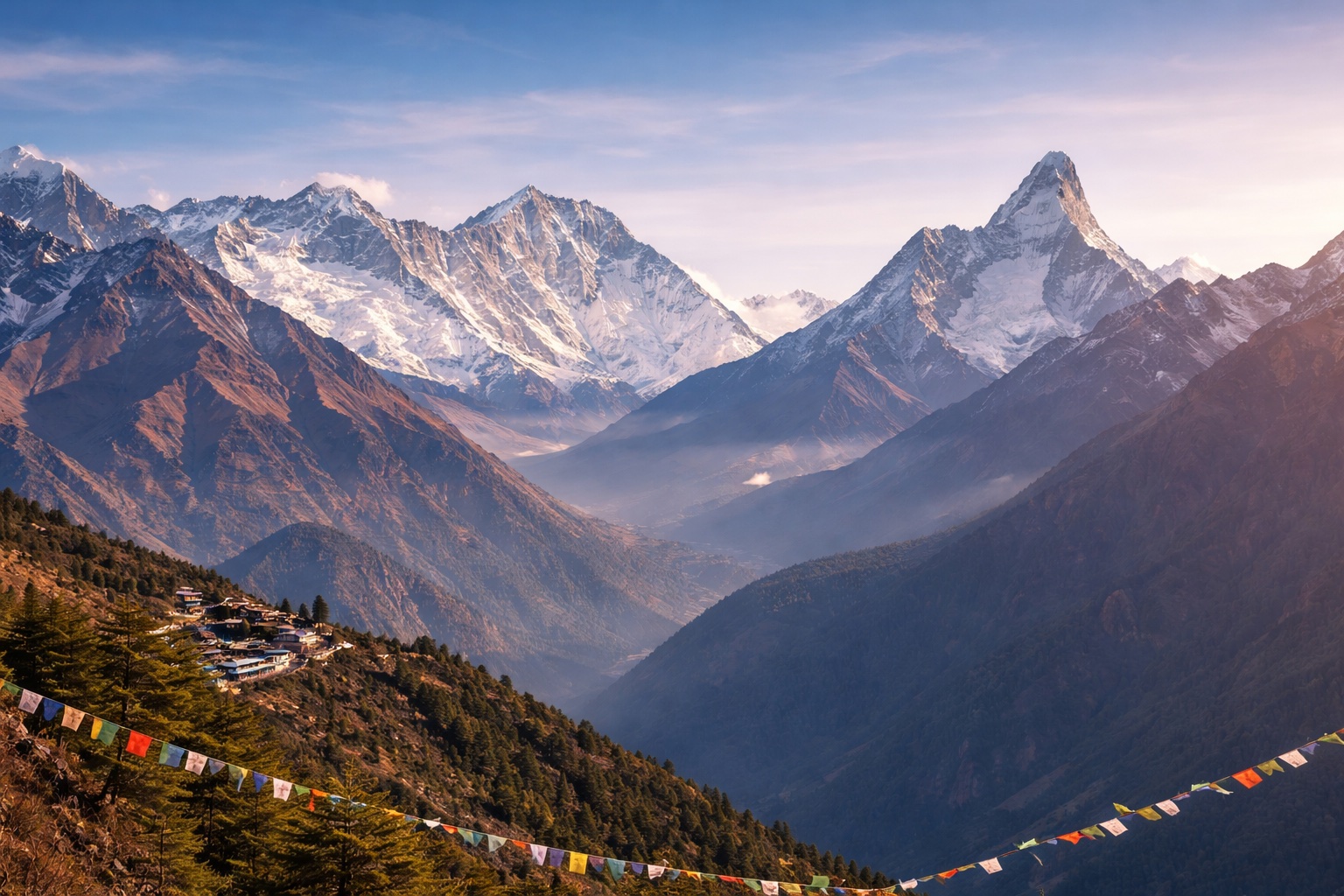
Nepal is one of the easiest countries in Asia to fall for. In a country roughly the size of England and Wales combined, the land climbs from the humid plains of the Terai, less than 100 metres above sea level, to the summit of Mount Everest, the highest point on Earth. Along the way are terraced hillsides, rhododendron forests, glacial valleys, medieval cities and some of the world's most sacred Hindu and Buddhist sites.
This Nepal travel guide brings together everything you need to plan your trip: the regions of the country, what to see and do, when to go, visas, money, transport, health, food, culture and etiquette, sample itineraries and practical tips. It is written by the Himalayan Hiking team, who live in Kathmandu and plan treks and tours across Nepal every season.
Nepal at a glance
| Fact | Details |
|---|---|
| Capital | Kathmandu |
| Population | About 30 million |
| Area | About 147,000 km² |
| Highest point | Mount Everest, 8,849 m |
| Languages | Nepali (official) and more than 120 other languages |
| Religions | Mainly Hindu and Buddhist, with Kirat, Muslim and Christian communities |
| Currency | Nepali rupee (NPR) |
| Time zone | UTC +5:45 |
| International airport | Tribhuvan International Airport, Kathmandu |
| UNESCO World Heritage Sites | Kathmandu Valley, Lumbini, Chitwan National Park, Sagarmatha National Park |
Geography: three bands from jungle to glacier
Nepal is often described as three long bands running east to west. In the south, the Terai is a strip of fertile plains and forest along the Indian border, home to national parks such as Chitwan and Bardia, and to Lumbini. North of the Terai, the Hills (Pahad) cover most of the country, with valleys, ridges and terraced farmland between about 700 and 4,000 metres; Kathmandu and Pokhara lie in this zone. Along the northern border rises the Himalaya (Himal), with eight of the fourteen peaks above 8,000 metres: Everest, Kanchenjunga, Lhotse, Makalu, Cho Oyu, Dhaulagiri, Manaslu and Annapurna I.
Great rivers such as the Koshi, Gandaki and Karnali cut through these bands from north to south, creating some of the deepest gorges in the world. That's why a short distance on the map can mean a long day on the road, and why Nepal packs so much into a small area.
People and culture
More than 120 ethnic groups live in Nepal, speaking over a hundred languages. The national census records more than 120 ethnic and caste groups and a similar number of languages. In the hills and mountains you meet Sherpa, Gurung, Magar, Tamang, Rai, Limbu and Thakali communities; in the Kathmandu Valley, the Newar people, whose art and architecture fill the valley's cities; and in the Terai, the Tharu, Maithili and other groups with close links to northern India.
Hinduism and Buddhism overlap here more than almost anywhere, and many temples, festivals and pilgrimage sites are shared by both. Religion is part of everyday life: morning offerings at neighbourhood shrines, prayer flags on mountain passes, butter lamps at monasteries and the ringing of temple bells are among the first things visitors notice.
Where to go in Nepal
Kathmandu Valley
The Kathmandu Valley is the political and cultural heart of Nepal. Its seven World Heritage monument zones include the Durbar Squares of Kathmandu, Patan and Bhaktapur, the great stupas of Swayambhunath and Boudhanath, and the Hindu temples of Pashupatinath and Changu Narayan. Most visitors spend at least two or three days here, often before or after a trek.
Pokhara
Pokhara, beside Phewa Lake beneath the Annapurna range, is Nepal's favourite place to relax. It is the gateway to Annapurna treks and a centre for paragliding, boating, cycling and short hikes to viewpoints such as Sarangkot and the World Peace Pagoda.
Everest region
The Everest region, or Khumbu, is home to Sherpa villages, Buddhist monasteries and the classic Everest Base Camp trek. It is reached by a short flight to Lukla or, for non-trekkers, by helicopter or scenic mountain flight.
Annapurna region
The Annapurna region has the widest choice of treks in Nepal, from the short Ghorepani Poon Hill trek to Annapurna Base Camp and the Annapurna Circuit over the Thorong La pass.
Langtang, Manaslu, Mustang and Kanchenjunga
Quieter trekking regions include Langtang, close to Kathmandu; Manaslu, around the world's eighth-highest mountain; Upper Mustang, a high desert with Tibetan culture; and Kanchenjunga, a remote region in the far east.
Chitwan and Bardia
In the Terai, you can go on jungle safaris in Chitwan National Park and Bardia National Park to see rhinos, crocodiles, birds and, with luck, Bengal tigers.
Lumbini and Janakpur
Lumbini, the birthplace of the Buddha, and Janakpur, the birthplace of Sita, are among the most important pilgrimage destinations in South Asia.
Top things to do in Nepal
- Trek in the Himalaya: from short treks to Everest Base Camp and the Annapurna Circuit.
- Climb a Himalayan peak: Island Peak, Mera Peak and other trekking peaks.
- Fly to Everest: by helicopter tour or scenic mountain flight.
- Explore World Heritage cities: Kathmandu, Patan and Bhaktapur.
- Go on a jungle safari: in Chitwan or Bardia National Park.
- Relax in Pokhara: boating, paragliding and sunrise views.
- Raft a Himalayan river: the Trishuli, Bhote Koshi or a multi-day expedition.
- Follow a pilgrimage: to Pashupatinath, Muktinath, Lumbini or Janakpur.
Best time to visit Nepal
Nepal's climate is shaped by altitude and by the South Asian monsoon. The main seasons are:
- Autumn (late September–November): the most popular season, with clear skies, stable weather and major festivals such as Dashain and Tihar. Good for trekking and sightseeing.
- Winter (December–February): cool, clear days and cold nights. Excellent for lower treks, Kathmandu tours and Chitwan safaris; high passes may be closed by snow.
- Spring (March–May): warm weather and rhododendrons in bloom. The second main trekking season and the Everest climbing season. The Terai becomes very hot in May.
- Monsoon (June–early September): rain, cloud and very green hills. Trekking is best in rain-shadow areas such as Upper Mustang; cultural tours continue.
Visas and entry requirements
Most nationalities can obtain a tourist visa on arrival at Tribhuvan International Airport in Kathmandu and at major land borders, or apply online before travelling. Visas are available for different lengths of stay and can be extended in Kathmandu or Pokhara. You need a passport valid for at least six months and passport photos. Indian citizens do not need a visa but must carry a valid passport or voter ID card. Visa rules and fees change from time to time, so check the latest requirements for your passport before you travel.
Money and costs
The currency is the Nepali rupee (NPR). ATMs are widely available in Kathmandu, Pokhara and larger towns, and credit cards are accepted in most mid-range and upscale hotels, restaurants and shops. In trekking areas and small towns, cash is essential. Money can be exchanged at banks and licensed exchange counters.
Nepal is good value, and your money goes a long way once you step outside the tourist restaurants. Costs depend on your style of travel: budget travellers can manage on simple guesthouses and local food, while comfortable hotels, private transport, guided treks, domestic flights and activities such as helicopter tours raise the budget. Tipping guides, porters and drivers at the end of a trip is customary and an important part of their income.
Getting around Nepal
Roads in Nepal are often winding and slow, so journeys take longer than distances suggest. The main options are:
- Domestic flights: connect Kathmandu with Pokhara, Lukla, Bharatpur (Chitwan), Bhairahawa (Lumbini), Nepalgunj, Biratnagar and other towns. Mountain flights depend on weather.
- Private vehicles: the most comfortable way to travel by road, with experienced drivers and flexible stops.
- Tourist buses: run daily between Kathmandu, Pokhara and Chitwan.
- Helicopters: for scenic tours, pilgrimages and rescues in the mountains.
Health and safety
Consult a travel health clinic before your trip about recommended vaccinations. In Nepal, drink only boiled, filtered or treated water, eat freshly cooked food and wash your hands often. If you are trekking, learn about altitude sickness and follow a gradual itinerary. Travel insurance is essential and must cover trekking to your maximum altitude and helicopter evacuation if you plan to trek or climb.
Most visitors find Nepal friendly and relaxed. Take normal precautions with valuables in busy areas, use registered taxis or arranged transport, trek with licensed guides, and follow local advice during strikes or protests. Check your government's travel advice before you go.
Food and drink
Nepali food is simple, fresh and filling. Dal bhat, rice with lentil soup, vegetable curry and pickle, is eaten twice a day by many families. Momos, steamed or fried dumplings, are the country's favourite snack. The Newar cuisine of the Kathmandu Valley, Thakali cooking in the Annapurna region and Tibetan dishes in mountain areas add variety. Masala tea is served everywhere, and Nepal also produces excellent tea and coffee in its hill districts.
Culture and etiquette
- Greet people with namaste, palms together.
- Remove your shoes before entering homes and temples.
- Walk clockwise around stupas, temples and mani walls.
- Dress modestly, especially at religious sites and in rural areas.
- Ask before photographing people, ceremonies and the interiors of temples.
- Use your right hand to give and receive things, and avoid touching people's heads.
- Some Hindu temples, including the main shrine at Pashupatinath, are open only to Hindus.
Sample Nepal itineraries
One week: Nepal highlights
Two days exploring the Kathmandu Valley, a flight to Pokhara for sunrise at Sarangkot and a boat on Phewa Lake, and two nights of jungle safari in Chitwan.
Ten days: culture and a short trek
Kathmandu sightseeing, the four- to five-day Ghorepani Poon Hill trek from Pokhara, and a day of relaxation by the lake.
Two weeks: a classic Himalayan trek
The Everest Base Camp trek or the Annapurna Base Camp trek, with sightseeing in Kathmandu before and a few days in Pokhara or Chitwan after.
Three weeks: the best of Nepal
A longer trek such as the Manaslu Circuit or the Annapurna Circuit, followed by Chitwan, Lumbini and the Kathmandu Valley, or a peak climb combined with the Everest Base Camp trek.
Combining Nepal with Tibet or Bhutan
Kathmandu is the gateway to the wider Himalaya. Direct flights connect Kathmandu with Lhasa in Tibet and Paro in Bhutan, making it easy to add a few days in either country to your Nepal trip. A popular combination is a week in Nepal followed by four or five days in Bhutan, or a Nepal trek followed by an overland journey through Tibet to Lhasa. We arrange all visas, permits and flights.
Travelling responsibly in Nepal
Tourism is an important source of income for many communities in Nepal. Choose a local company that treats its guides and porters fairly, stay in family-run lodges, buy handicrafts from local artisans, carry a refillable water bottle instead of buying plastic, respect local customs and religious sites, and leave trails and villages as clean as you found them.
Nepal's UNESCO World Heritage Sites
Nepal has four sites on the UNESCO World Heritage List, two cultural and two natural. The Kathmandu Valley is listed as seven monument zones: the Durbar Squares of Kathmandu, Patan and Bhaktapur, the Buddhist stupas of Swayambhunath and Boudhanath, and the Hindu temples of Pashupatinath and Changu Narayan. Lumbini, the birthplace of the Buddha, is revered by Buddhists around the world. Sagarmatha National Park protects the Everest region, with the world's highest mountain, glaciers and Sherpa culture. Chitwan National Park protects subtropical forest and grassland home to rhinos, tigers and hundreds of bird species. Visiting all four in one trip is possible with a well-planned itinerary of around two weeks.
Festivals of Nepal
Nepal is often said to have more festivals than days in the year. Most follow the lunar calendar, so dates change every year. Dashain, usually in September or October, is the biggest national festival, when families gather, elders give blessings with red tika, and kites fill the sky. Tihar, the festival of lights, follows soon after, with oil lamps, marigold garlands and days honouring crows, dogs, cows and brothers. In the Kathmandu Valley, Indra Jatra brings masked dances and the chariot procession of the living goddess Kumari, while Bisket Jatra celebrates the Nepali New Year in Bhaktapur each April. Holi, the festival of colours, fills the streets with coloured powder in spring, and Maha Shivaratri draws thousands of pilgrims and sadhus to Pashupatinath. In the mountains, Buddhist festivals such as Mani Rimdu at Tengboche and Tiji in Lo Manthang feature masked monastic dances, and Losar, the Tibetan and Sherpa New Year, is celebrated in Boudhanath and mountain villages.
Trekking in Nepal: an overview
For many visitors, trekking is the highlight of a trip to Nepal. Most popular routes are teahouse treks, where you walk from village to village and sleep in family-run lodges, carrying only a daypack while porters carry the luggage. Treks range from easy three-day walks near Pokhara and Kathmandu to high-altitude journeys of three weeks or more. The most famous are the Everest Base Camp trek, the Annapurna Base Camp trek, the Annapurna Circuit, the Langtang Valley trek and the Manaslu Circuit. Most national parks and conservation areas require permits, and Nepal's rules require most foreign trekkers to walk with a licensed guide. Our Things to Do section explains each region and type of trek in detail.
Adventure activities
Trekking gets most of the attention, but there's plenty more to do outdoors. Beyond trekking, you can climb a Himalayan trekking peak such as Island Peak or Mera Peak, raft white-water rivers such as the Trishuli, Bhote Koshi and Sun Koshi, go tandem paragliding over Phewa Lake in Pokhara, ride one of the world's longest ziplines, go canyoning or bungee jumping near the Tibetan border, and mountain bike through villages and along ridges. Most activities can be added to a trek or tour for a day or two.
Nepal with children
Nepal works well for families. Children love boating on Phewa Lake, watching monkeys at Swayambhunath, spotting rhinos from a jeep in Chitwan, trying their hand at pottery in Bhaktapur and walking short treks such as Australian Camp or Ghorepani Poon Hill. Nepali people are warm towards children, and kids tend to make friends everywhere. For families, we recommend private transport, flights for longer journeys, flexible itineraries with rest time and hotels with gardens or pools in the lowlands.
Communication and connectivity
Local SIM cards with data are cheap and easy to buy in Kathmandu with your passport and a photo, and mobile coverage is good in cities and along many trekking routes. Wi-Fi is available in most hotels, cafés and lodges on popular treks, although it can be slow in the mountains. Electricity uses 230 V with round-pin plugs; a universal adaptor is useful. Power cuts are much rarer than in the past but can still occur.
Shopping in Nepal
Nepal is a great place to shop for handicrafts. Popular souvenirs include pashmina shawls, hand-knotted carpets, singing bowls, thangka paintings, bronze statues from Patan, pottery from Bhaktapur, handmade lokta paper, felt crafts, prayer flags, tea and coffee from the hill districts, and trekking gear in Thamel. Bargaining is normal in markets and small shops. Fair-trade shops in Kathmandu and Patan support women's groups and artisans across the country.
Nepal's national parks and wildlife
Nepal protects around a quarter of its land in national parks, conservation areas and wildlife reserves. In the lowlands, Chitwan, Bardia, Parsa, Banke and Shuklaphanta national parks shelter the greater one-horned rhinoceros, Bengal tiger, Asian elephant, gharial crocodile and swamp deer. In the mountains, Sagarmatha, Langtang, Makalu Barun, Shey Phoksundo and the Annapurna, Manaslu and Kanchenjunga conservation areas protect red pandas, snow leopards, Himalayan tahr, blue sheep and the Danphe, Nepal's colourful national bird. Nepal has become a global leader in conservation: its wild tiger population has roughly tripled in little more than a decade, and several recent years have passed with no rhinos lost to poaching. Entry fees paid by visitors help fund this work and the communities around the parks.
Pokhara and the lake region in more depth
Many visitors find Pokhara the most relaxing place in Nepal. Lakeside, the town's tourist area, runs along the eastern shore of Phewa Lake, lined with cafés, bookshops and hotels with views of the Annapurna range. Beyond the obvious sights of Sarangkot, the World Peace Pagoda and the Tal Barahi temple, the valley has quieter lakes such as Begnas and Rupa, Tibetan settlements where refugee families make carpets and handicrafts, caves and waterfalls carved by the Seti river, and hill villages reached on short walks. Pokhara makes a perfect base for a few days of rest before or after a trek in the Annapurna region.
Travelling in Nepal on a budget or in comfort
Nepal suits every travel style. On a budget, you can stay in simple guesthouses, eat local dal bhat and momos, travel by tourist bus and trek on teahouse routes. Mid-range travellers usually choose comfortable hotels, private vehicles, domestic flights and guided treks with porters. At the top end, Nepal has heritage hotels in the Kathmandu Valley, luxury lodges on the Everest and Annapurna trails, jungle resorts in Chitwan and private helicopter tours. Whatever your budget, a good local guide adds enormous value, explaining the culture, handling logistics and keeping you safe.
Where to stay in Nepal
Kathmandu has everything from backpacker guesthouses in Thamel to heritage hotels in restored Newar palaces and international chains. Pokhara has lakeside hotels and resorts with mountain views, Chitwan has jungle lodges on the edge of the park, and trekking routes are lined with family-run teahouses.
Plan your Nepal trip with Himalayan Hiking
Our office is in Kathmandu. We plan treks, tours, climbs, safaris and pilgrimages across Nepal, with hotels, transport, permits and licensed guides arranged. Browse our Nepal trips above, or contact us with your dates and interests and we will design an itinerary around you.