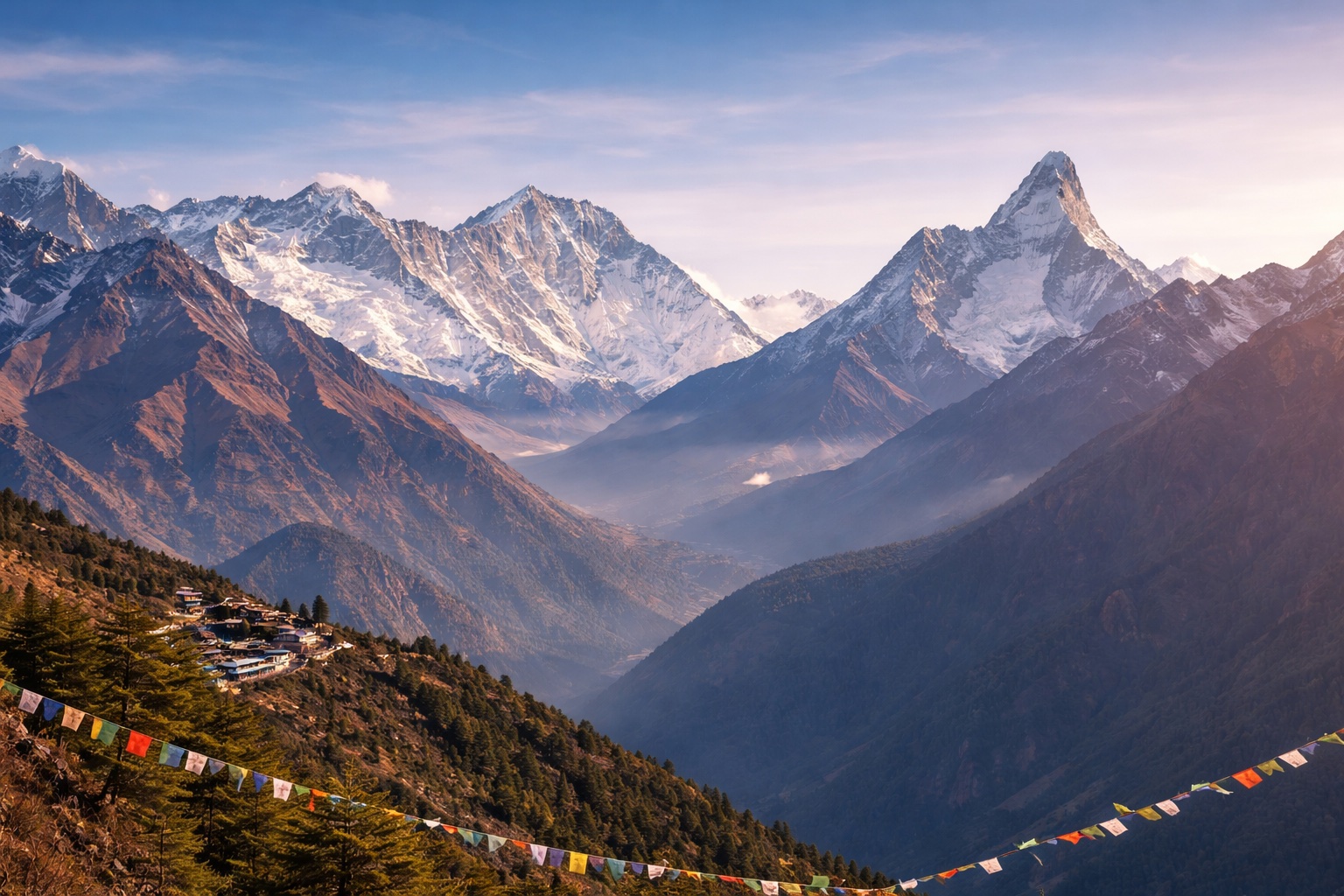
The Upper Mustang trek is a 14-day guided trek to the former Kingdom of Lo, a high desert behind the Himalaya where Tibetan Buddhist culture has survived almost unchanged. Fly from Pokhara to Jomsom, walk through Kagbeni into the restricted area, and cross wind-carved ridges past red cliffs, cave dwellings and whitewashed villages to the walled capital of Lo Manthang (3,840 m), with its 15th-century monasteries.
The trek is moderate, with no very high passes, and because Mustang lies in the rain shadow of the Himalaya it is one of the few treks in Nepal that is excellent during the monsoon. The best time is March to November. We arrange the Upper Mustang Restricted Area Permit, ACAP, Jomsom flights, a licensed guide, porters and teahouse lodges with meals.
Hidden behind Dhaulagiri and the Annapurnas, Upper Mustang was an independent kingdom for centuries and was closed to foreign visitors until 1992. Its landscape is unlike anywhere else in Nepal: a high, dry plateau of eroded cliffs in red, ochre and grey, deep canyons, and fortified villages surrounded by barley fields and poplar trees. Thousands of man-made sky caves are carved into the cliffs, some used for burials and meditation for more than two thousand years.
The people of Mustang, the Lobas, follow Tibetan Buddhism and speak a Tibetan dialect. Their capital, Lo Manthang, is a walled city of narrow lanes, whitewashed houses and the old royal palace, with three great monasteries whose wall paintings are among the finest in the Himalaya.
| Trip fact | Details |
|---|---|
| Duration | 14 days from Kathmandu (10 days of trekking) |
| Highest point | About 4,200 m on the passes; Lo Manthang 3,840 m |
| Grade | Moderate |
| Daily walking | 5–7 hours |
| Start and finish | Kathmandu, via Pokhara and Jomsom flights |
| Accommodation | Hotels in Kathmandu and Pokhara, teahouse lodges on the trek |
| Permits | Upper Mustang Restricted Area Permit and ACAP |
| Rules | Minimum 2 trekkers with a licensed guide |
| Best time | March to November, including the monsoon |
After a drive or flight to Pokhara, a 20-minute morning flight squeezes between Dhaulagiri and the Annapurnas to Jomsom. Sit on the right for the best view. You walk up the Kali Gandaki valley to Kagbeni, where the restricted area begins, and continue through Chele, Syangboche and Ghami, crossing ridges with views back to the Annapurnas and Nilgiri. Past the longest mani wall in Mustang, you reach Tsarang and finally Lo Manthang.
A full day in Lo Manthang allows you to explore the monasteries and palace and make an excursion to the Chhoser cave complex or Namgyal Gompa. The return follows a different route via Lo Gekar (Ghar Gompa), one of the oldest monasteries in Nepal, and the red cliffs of Dhakmar, before returning to Jomsom and flying to Pokhara.
Upper Mustang is a restricted area. You need the Upper Mustang Restricted Area Permit, issued for a set period with extra fees for additional days, and the Annapurna Conservation Area Permit. Restricted area permits are issued only through a registered agency to groups of at least two trekkers with a licensed guide. All permits are included in this trip.
The trek is moderate. There are no passes above about 4,200 m, and most nights are spent between 3,000 and 3,900 m. The challenges are the dry climate, strong afternoon winds, dust and sun, and some long days crossing ridges and dry riverbeds. Good fitness, sun protection and plenty of water make the trek comfortable.
Mustang can be trekked from March to November. Spring is mild, with the Tiji festival in May; the monsoon (June–August) is one of the best times, with green barley fields and few other trekkers, as the region receives little rain; autumn brings clear skies and harvest time. In winter it is very cold, and many residents of Lo Manthang move south.
The three-day Tiji festival in Lo Manthang, usually held in May, celebrates the victory of the deity Dorje Jono over a demon who brought drought to the land. Monks perform masked dances in the main square. Dates follow the Tibetan calendar; ask us about festival departures.
Upper Mustang is now a teahouse trek, with simple, clean lodges in every overnight village and more comfortable options in Lo Manthang. Food includes dal bhat, Tibetan bread, noodles, buckwheat pancakes and tsampa, and in Lower Mustang, the famous apple pie and Thakali dal bhat.
Expect 5–7 hours on your feet most days, often on steep stone steps. Two or three months of regular hill walking, stairs and cardio will make a big difference, and wear your boots in at home, not on the trail.
You will reach about 4,200 m on the passes, with most nights between 3,000 and 3,900 m on this trek. Watch for headache, nausea, dizziness and trouble sleeping, and tell your guide about any of them early. The basics work: walk slowly, drink plenty of water, avoid alcohol, and if things get worse, descend. It is worth asking your doctor about altitude medication before the trip.
Mustang is dry and sunny, with cold mornings and evenings and strong winds in the afternoon. Summer days are warm; spring and autumn nights are near or below freezing.
Pokhara – Jomsom flights operate only in the morning and depend on the weather, so delays are possible. The baggage limit is usually around 15 kg per person including hand luggage.
The Upper Mustang Restricted Area Permit (10 days) and ACAP are included. Restricted area permits require at least two trekkers and a licensed guide.
Bring enough Nepali rupees from Kathmandu or Pokhara for extras on the trek; ATMs are rare and unreliable in the mountains. Battery charging, hot showers and Wi-Fi are usually paid extras in lodges, and a power bank is useful.
Skip the plastic bottles. Lodges sell boiled or filtered water, or you can treat tap water with tablets or a filter and refill your own bottle.
We can't take you on the trek without insurance. Check that your policy covers trekking to 4,500 m and emergency helicopter evacuation, and send us the details before you travel.
Most nationalities can get a Nepal tourist visa on arrival at Kathmandu airport or apply online in advance. Bring a passport valid for at least six months and passport photos for permits.
Choose add-ons and quantities on the booking form.
More trip options, quoted on request:
This itinerary takes 14 days from Kathmandu, with 10 days of trekking and a full day in Lo Manthang.
Yes, the Upper Mustang Restricted Area Permit and ACAP, both included. The restricted permit requires at least two trekkers and a licensed guide.
Mainly because of the restricted area permit, which is charged for a set period, and the Jomsom flights. The rest of the costs are similar to other treks.
Yes. Mustang is in the rain shadow of the Himalaya and receives little rain, so June–August is a good time. Jomsom flights can still be delayed by weather further south.
It is moderate, with no passes above about 4,200 m. The main challenges are wind, dust, sun and some long days.
Usually in May, over three days in Lo Manthang. Dates follow the Tibetan calendar; ask us for this year's dates.
It is the walled capital of the former Kingdom of Lo, with the royal palace and 15th-century monasteries famous for their wall paintings.
Yes, a road now reaches Lo Manthang. This itinerary uses footpaths away from the road wherever possible, especially on the return via Ghar Gompa.
Photography is often not allowed inside the monasteries, to protect the wall paintings. Your guide will explain the rules at each site.
No. Bring enough Nepali rupees from Kathmandu or Pokhara for the whole trek.
Yes, Muktinath can be added as a side trip from Kagbeni or Jomsom.
It's priced per person, and groups get a discount; the price box has the details. It includes the restricted permit, ACAP, flights, hotels, lodges, meals on the trek, a guide and porters.