
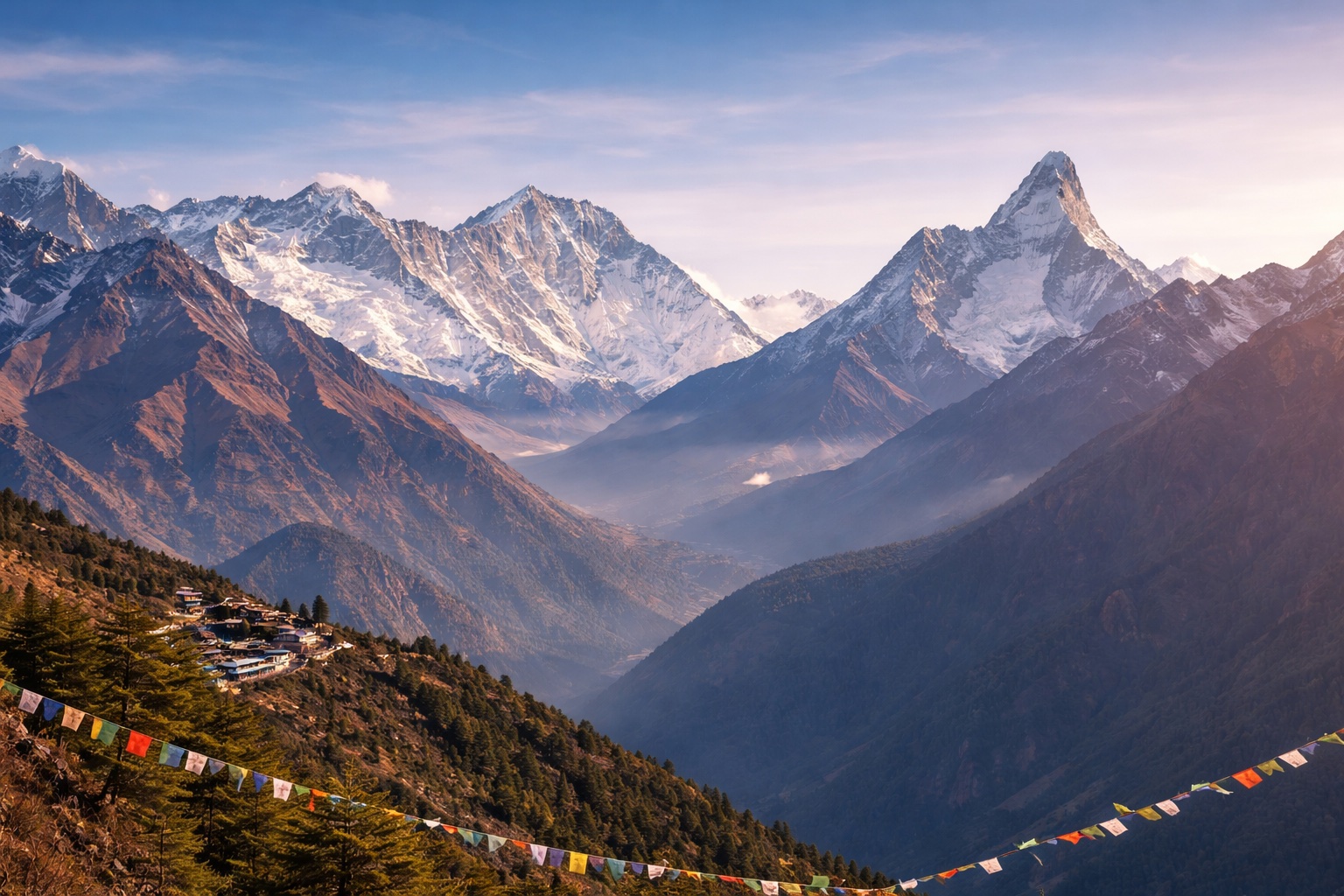
Bhutan travel guide: planning a tour from Nepal
Bhutan is a small Himalayan kingdom between India and Tibet, and one of the most distinctive travel destinations in the world. Mountain valleys are dominated by massive white dzongs, fortress monasteries that serve as both religious and government centres. Prayer flags flutter on every pass, archery matches echo across village fields, and people still wear the national dress of the gho and kira in daily life. More than two-thirds of the country is covered in forest, protected by law.
This Bhutan travel guide explains how to visit Bhutan from Nepal: visas and the Sustainable Development Fee, the flight from Kathmandu to Paro, the main highlights, festivals, treks, the best time to go, practical tips and etiquette. It is written by the Himalayan Hiking team in Kathmandu, who arrange Bhutan tours with licensed partners in Bhutan.
Bhutan at a glance
| Fact | Details |
|---|---|
| Official name | Kingdom of Bhutan (Druk Yul, "Land of the Thunder Dragon") |
| Capital | Thimphu |
| Population | Under one million |
| Main religion | Vajrayana (Tibetan-style) Buddhism |
| Language | Dzongkha (official); English widely spoken |
| Currency | Ngultrum (BTN), pegged to the Indian rupee |
| International airport | Paro |
| Time zone | UTC +6 |
Gross National Happiness and "high value, low impact" tourism
Bhutan is famous for Gross National Happiness, a development philosophy that measures progress not only by economic growth but by wellbeing, culture, good governance and the environment. The constitution requires that at least 60 per cent of the country remain under forest cover, and Bhutan is often described as carbon-negative, absorbing more carbon than it emits.
Tourism follows the same principles. Instead of mass tourism, Bhutan welcomes visitors under a policy of "high value, low impact" travel. Most visitors pay a daily Sustainable Development Fee (SDF), which funds conservation, free health care, education and infrastructure. The result is a country where historic sites are uncrowded, forests are intact and culture remains strong.
Visas and the Sustainable Development Fee
Most visitors need a Bhutan visa, which is applied for online before travel, usually through a licensed tour operator or a registered hotel, and approved before you fly. You need a passport valid for at least six months, a passport photo, flight details and travel insurance. The visa fee and the Sustainable Development Fee are paid in advance for each night of your stay. The SDF rate is set by the government of Bhutan and has changed in recent years, so we always include the current rate in your quote.
Indian citizens do not need a visa but must obtain an entry permit and pay a lower SDF in Indian rupees; citizens of Bangladesh and the Maldives also have special arrangements. A licensed guide is required for most travel outside the main towns of Thimphu and Paro and for all treks.
Flying from Kathmandu to Paro
The flight from Kathmandu to Paro, run by Bhutan's national airlines, flies along the Himalaya; sit on the left for Everest and Kanchenjunga. The journey takes about an hour. On a clear day, passengers on the left side of the aircraft from Kathmandu see a long line of Himalayan giants, including Everest, Lhotse, Makalu and Kanchenjunga. The descent into Paro, between forested ridges into a narrow valley, is famous, and only specially trained pilots are allowed to land there. Flights are limited, so book early, especially during festival seasons.
Bhutan can also be reached overland from India via the border towns of Phuentsholing, Gelephu and Samdrup Jongkhar, making it possible to combine Bhutan with Sikkim or West Bengal.
Highlights of Bhutan
Paro and Tiger's Nest
The Paro valley is where most visitors begin. Its greatest sight is Paro Taktsang, the Tiger's Nest Monastery, clinging to a sheer cliff about 900 metres above the valley floor. According to legend, Guru Rinpoche flew here on the back of a tigress in the 8th century to meditate in a cave. The hike to the monastery is the highlight of most trips to Bhutan. Paro also has the impressive Rinpung Dzong, the National Museum in the old watchtower of Ta Dzong, and Kyichu Lhakhang, one of the oldest temples in the country.
Thimphu
Thimphu, the capital, is one of the few capitals in the world without traffic lights; police officers direct traffic at the main junction. Highlights include Tashichho Dzong, seat of the government and the central monastic body; the giant Buddha Dordenma statue overlooking the valley; the National Memorial Chorten, where residents circle the stupa throughout the day; the weekend market; and centres for traditional arts, paper-making and textiles.
Dochu La pass
On the road from Thimphu to Punakha, the Dochu La pass, at about 3,100 m, is crowned by 108 memorial chortens. On clear days, especially in winter, there are panoramic views of the eastern Himalaya, including Bhutan's highest peaks.
Punakha
The warm Punakha valley was Bhutan's capital until the 1950s. Punakha Dzong, at the confluence of the Pho Chhu and Mo Chhu ("father" and "mother" rivers), is often considered the most beautiful dzong in the country, especially in spring when jacaranda trees bloom around it. Nearby, a walk through rice fields leads to Chimi Lhakhang, the fertility temple of the "Divine Madman", Drukpa Kunley, and a suspension bridge and hike lead to the Khamsum Yulley Namgyal Chorten.
Phobjikha valley
The glacial Phobjikha valley, with its wide wetlands and the Gangtey Monastery, is the winter home of endangered black-necked cranes, which arrive from Tibet in late autumn. A crane festival celebrates their arrival.
Bumthang
In central Bhutan, the four valleys of Bumthang are the country's spiritual heartland, with some of its oldest temples, including Jambay Lhakhang and Kurje Lhakhang, as well as cheese, honey and apple production.
Festivals: the tshechus
Bhutan's tshechus are religious festivals held in dzongs and temples to honour Guru Rinpoche. Monks and laymen perform cham, sacred masked dances, in the courtyards, while local people gather in their finest clothes to watch, socialise and receive blessings. The most famous are the Paro Tshechu in spring and the Thimphu Tshechu in autumn. At many tshechus, a giant thangka (thongdrel) is unveiled at dawn on the final day. Dates follow the Bhutanese lunar calendar, and flights and hotels fill up early, so book festival tours well in advance.
Trekking in Bhutan
Bhutan's treks are some of the most remote in the Himalaya, and you'll see very few other people. The Druk Path Trek, between Paro and Thimphu, is a short trek of about five or six days over ridges and past high lakes. The Jomolhari Trek leads to the base of the sacred Mount Jomolhari, with yak herders' camps and high passes. The legendary Snowman Trek is one of the hardest treks in the world, crossing many high passes over about three weeks. Bhutan's treks are generally camping treks with a full crew and require a licensed guide.
Sample Bhutan itineraries
| Tour | Length | Highlights |
|---|---|---|
| Bhutan short tour | 4 days | Paro, Tiger's Nest, Thimphu |
| Classic western Bhutan | 5–6 days | Paro, Thimphu, Dochu La, Punakha, Tiger's Nest |
| Bhutan in depth | 8–10 days | Adds Phobjikha valley and Bumthang |
| Festival tour | 5–8 days | Paro or Thimphu Tshechu with sightseeing |
| Druk Path Trek | 7–9 days | Trek between Paro and Thimphu with sightseeing |
Best time to visit Bhutan
- March–May: spring flowers, rhododendrons and the Paro Tshechu; pleasant temperatures.
- June–August: the monsoon brings rain and cloud; landscapes are green and visitors fewer.
- September–November: clear skies, harvest season and the Thimphu Tshechu; the most popular time.
- December–February: cold but clear, with the best Himalayan views from Dochu La and the black-necked cranes in Phobjikha.
Accommodation and food
Bhutan has a range of hotels approved for tourists, from comfortable locally run hotels with traditional architecture to some of the most exclusive luxury lodges in Asia. A farmhouse stay is the best way to see rural Bhutan.
Bhutanese food is known for its love of chillies, which are eaten as a vegetable rather than a spice. The national dish, ema datshi, is chillies cooked in cheese. Other favourites include kewa datshi (potatoes and cheese), shamu datshi (mushrooms and cheese), red rice, buckwheat noodles and momos. Hotels usually serve a milder buffet for visitors, and vegetarian food is widely available.
Culture and etiquette
- Dress modestly, with long sleeves and long trousers or skirts when visiting dzongs and temples; hats are removed inside.
- Walk clockwise around chortens, temples and prayer wheels.
- Photography is not allowed inside most temples and dzongs; your guide will explain the rules.
- Do not point your feet at altars or touch religious objects.
- Smoking is heavily restricted, and tobacco rules are strict; check the latest regulations before you travel.
- Show respect for the royal family, who are deeply loved in Bhutan.
Money and practical tips
The ngultrum is pegged to the Indian rupee, and Indian rupees in smaller denominations are widely accepted. ATMs are available in larger towns, and some hotels and shops accept cards, but carry cash for small purchases. Mobile coverage is good in most towns, and local SIM cards are easy to buy. Tipping guides and drivers at the end of a tour is appreciated. Altitudes on the main tourist routes are moderate, but the hike to Tiger's Nest and mountain passes involve some exertion, and treks go much higher.
Combining Bhutan with Nepal
Because of the direct flights between Kathmandu and Paro, Bhutan combines perfectly with Nepal. A popular two-week journey spends a week in Nepal, with the Kathmandu Valley, Pokhara or a short trek, followed by five or six days in western Bhutan. Bhutan can also be combined with Tibet for a three-country Himalayan tour, or with Sikkim and Darjeeling in India overland.
A short history of Bhutan
Bhutan emerged as a unified state in the 17th century under Zhabdrung Ngawang Namgyal, a Tibetan lama who built many of the great dzongs and created a dual system of religious and civil government. In 1907, Ugyen Wangchuck became the first hereditary king, founding the Wangchuck dynasty that still rules today. Bhutan remained largely closed to the outside world until the 1960s and first admitted foreign tourists in 1974. In 2008, the fourth king voluntarily introduced parliamentary democracy, and Bhutan became a constitutional monarchy. The kings are deeply respected, and their portraits hang in homes, shops and offices across the country.
Dzongs: fortresses of faith and government
The dzong is Bhutan's most distinctive building. These massive fortresses, with tapering white walls, red-painted windows and golden roofs, were built at strategic points in each valley to defend against invasion. Today they house both the district administration and the monastic body, with courtyards for government offices on one side and temples and monks' quarters on the other. Dzongs are built without nails or written plans, following traditional techniques passed down through generations. The most famous include Punakha Dzong, Rinpung Dzong in Paro, Tashichho Dzong in Thimphu and Trongsa Dzong in central Bhutan.
Archery, the national sport
Archery is Bhutan's national sport and a central part of social life. Teams compete over distances of around 140 metres, far longer than Olympic archery, with singing, dancing and good-natured teasing of opponents between shots. Traditional bamboo bows are still used, alongside modern compound bows. Watching a match is one of the most enjoyable cultural experiences on a Bhutan tour, and your guide can help you find a local tournament.
Textiles and traditional arts
Bhutan is famous for its hand-woven textiles, woven by women on backstrap and floor looms in intricate patterns that can take months to complete. The kingdom officially recognises thirteen traditional arts, known as zorig chusum, including painting, sculpture, woodcarving, calligraphy, paper-making, bronze casting, embroidery and weaving. In Thimphu, the Institute of Zorig Chusum and the Royal Textile Academy allow visitors to see students and artisans at work and to learn about the meaning of patterns and colours.
Nature and wildlife
Bhutan is one of the world's biodiversity hotspots. Protected areas and biological corridors cover about half the country, from subtropical forests in the south to alpine meadows and glaciers in the north. The national animal is the unusual takin, a goat-antelope that can be seen in a preserve near Thimphu. The forests shelter red pandas, Himalayan black bears, golden langurs and, in the south, tigers and elephants in Royal Manas National Park. Birdwatchers will find hundreds of species, including the rare white-bellied heron and the black-necked cranes of Phobjikha.
Farmhouse stays and hot stone baths
To see rural life, many visitors spend a night in a traditional Bhutanese farmhouse, with thick rammed-earth walls, carved wooden windows and an altar room. You eat home-cooked meals with the family, try ara (local spirit) and butter tea, and learn about village farming. Many farmhouses also have a hot stone bath: a wooden tub of water heated with red-hot river stones and medicinal herbs. Exactly what you want after the Tiger's Nest hike.
Eastern Bhutan
Most visitors stay in western and central Bhutan, but the rarely visited east rewards those with more time. Winding roads cross high passes to Mongar, Lhuentse, the ancestral home of the royal family and a centre of textile weaving, and Trashigang, whose dzong sits on a spur high above the river. Villages in the east are among the most traditional in the country, and some trips exit Bhutan overland to India via Samdrup Jongkhar, combining Bhutan with Assam.
What does a Bhutan tour cost?
The cost of a Bhutan tour depends mainly on the number of nights, as the Sustainable Development Fee is charged per night for most visitors, together with the standard of hotels, the season, the size of your group and flights to and from Paro. Most packages include the visa, SDF, hotels, meals, a licensed guide, a private vehicle and driver, and entrance fees. Luxury lodges and festival periods cost more. We provide a clear, itemised quote so you know exactly what is included.
Bhutan's Buddhist traditions
Buddhism shapes every part of life in Bhutan. The country follows the Drukpa Kagyu school of Vajrayana Buddhism, and monasteries, temples and chortens are found in every valley. The 8th-century teacher Guru Rinpoche, who is believed to have brought Buddhism to Bhutan, is revered as a second Buddha, and many sacred sites, including Tiger's Nest and Kurje Lhakhang in Bumthang, are associated with his meditation. Prayer flags on ridges, prayer wheels turned by streams and white flags raised for the dead are part of the landscape. Visitors are welcome at most temples and dzongs, with guidance from their licensed guide on etiquette and dress.
The hike to Tiger's Nest
For most visitors, the hike to Paro Taktsang is the highlight of Bhutan. The trail begins in pine forest at the valley floor and climbs steadily for about two to three hours, gaining roughly 500 metres. Halfway up, a cafeteria serves tea, and you get your first good look at the monastery on its cliff. The final section follows a path around the cliff, descending steps to a waterfall and then climbing to the monastery gate. Inside, visitors can see several shrines, including the cave where Guru Rinpoche is said to have meditated. Photography is not allowed inside, and bags and phones are left at the entrance. Start early in the morning for cooler temperatures and fewer people.
Bhutan for families and older travellers
Bhutan is a relaxed and safe destination for families and older travellers. Distances are short in western Bhutan, hotels are comfortable, and private vehicles with drivers make travel easy. Children enjoy archery matches, the takin preserve, farmhouse visits and festival dances, while older travellers appreciate the calm pace and cultural depth. The main physical challenge is the hike to Tiger's Nest, which can be shortened by riding a horse for part of the ascent or by enjoying the view from the halfway cafeteria.
Punakha, Wangdue and the central valleys
East of the Dochu La, the road descends into the warm, fertile valleys of Punakha and Wangdue Phodrang, where rice terraces, orange orchards and banana trees contrast with the pine forests of Thimphu. Beyond Punakha, many tours continue east over the Pele La pass to Trongsa, whose huge dzong once controlled trade between east and west Bhutan, and to Bumthang, the religious heartland. This longer route shows how varied Bhutan is, and suits travellers with eight days or more.
Shopping and souvenirs
Popular souvenirs from Bhutan include hand-woven textiles, kira and gho fabric, handmade Deh-sho paper, prayer flags, incense, wooden bowls, masks used in festival dances, thangka paintings, Bhutanese red rice, buckwheat honey and local tea. Thimphu's craft bazaar and the handicraft shops in Paro have a good selection. Genuine antiques cannot be exported, so buy from reputable shops that can advise on what is allowed.
Book your Bhutan tour with Himalayan Hiking
Our office is in Kathmandu. Working with licensed partners in Bhutan, we arrange Bhutan tours, festival trips and treks, including the Bhutan visa, Sustainable Development Fee, flights from Kathmandu, hotels, private transport and licensed Bhutanese guides. Contact us with your dates and interests, and we will send a tailor-made itinerary and quote.