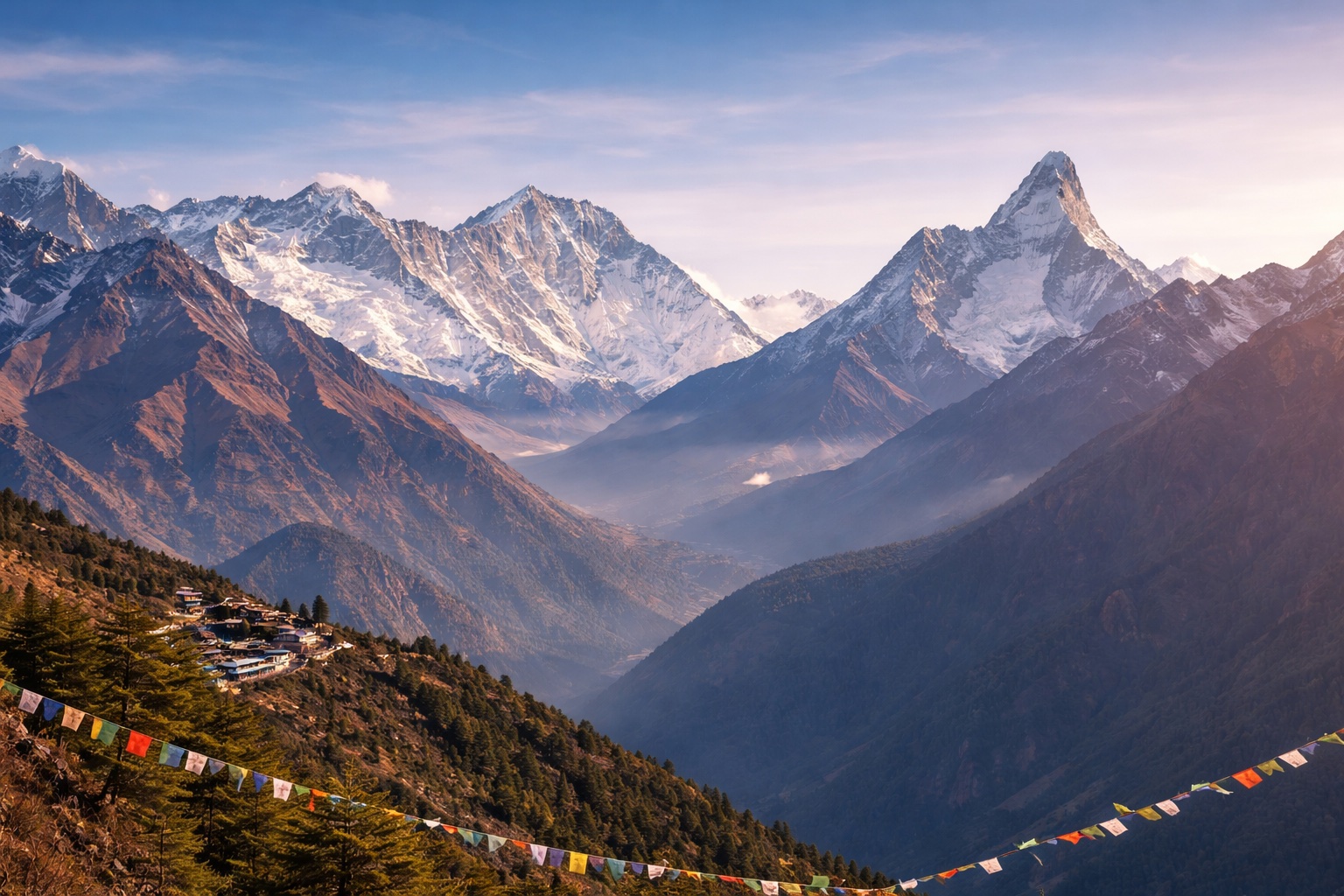
The Mardi Himal trek is a 7-day guided trek from Kathmandu up a narrow grassy ridge beneath Machhapuchhre (6,993 m) and Mardi Himal (5,587 m) in the Annapurna region. From Pokhara, you walk through quiet rhododendron forest to Low Camp and High Camp (3,580 m), then climb at dawn to the Mardi Himal viewpoint and on towards Mardi Himal Base Camp (about 4,500 m), with close views of the fishtail peak, Annapurna South and Hiunchuli.
This short trek is quieter than Poon Hill and the Annapurna Base Camp trail, graded moderate and best from March–May and September–December. A licensed guide, porters, the ACAP permit, transport, hotels and teahouse lodges with meals are all arranged by our team in Kathmandu.
The Mardi Himal trek opened to trekkers in 2012 and has quickly become one of the favourite short treks near Pokhara. Instead of following a valley, it climbs a long forested ridge east of the Annapurna Sanctuary. After two days in moss-draped rhododendron and oak forest, the trail breaks out above the tree line onto open grassy ridges with the fishtail peak of Machhapuchhre towering directly ahead.
The highlight is the dawn climb from High Camp to the Mardi Himal viewpoint and beyond, where the ridge narrows and the view opens to Annapurna South, Hiunchuli, Mardi Himal and the great wall of the Annapurnas. Because the route is newer and has fewer lodges, it is much quieter than the classic trails.
| Trip fact | Details |
|---|---|
| Duration | 7 days from Kathmandu (4 days of trekking) |
| Highest overnight stop | High Camp, 3,580 m |
| Highest point | Mardi Himal Base Camp area, about 4,500 m |
| Grade | Moderate |
| Daily walking | 4–7 hours |
| Start and finish | Kathmandu, via Pokhara |
| Accommodation | Hotels in Kathmandu and Pokhara, teahouse lodges on the trek |
| Permit | Annapurna Conservation Area Permit (ACAP) |
| Best time | March–May and September–December |
The trek is moderate. The first days are gentle forest walks, but the climb from High Camp to the viewpoint and base camp area is steep, and the altitude above 4,000 m requires a slow pace. Fit walkers with some hiking experience will enjoy it. The descent from High Camp to Siding is long and steep.
October–December brings the clearest views, March–May the rhododendron blossom. In winter, snow can make the upper ridge slippery; in the monsoon, the forest is wet and leeches are common.
Poon Hill is lower and easier, with a panoramic sunrise over Dhaulagiri and the Annapurnas. Mardi Himal is higher and quieter, taking you much closer to the mountains, especially Machhapuchhre. Both are four-day walks from Pokhara.
Expect 5–7 hours on your feet most days, often on steep stone steps. Two or three months of regular hill walking, stairs and cardio will make a big difference, and wear your boots in at home, not on the trail.
You will reach about 4,500 m near Mardi Himal Base Camp, with the highest night at High Camp (3,580 m) on this trek. Watch for headache, nausea, dizziness and trouble sleeping, and tell your guide about any of them early. The basics work: walk slowly, drink plenty of water, avoid alcohol, and if things get worse, descend. It is worth asking your doctor about altitude medication before the trip.
The forest is mild; the open ridge above Low Camp is exposed to wind and can be cold and misty, with snow in winter. Mornings are usually the clearest.
The Annapurna Conservation Area Permit (ACAP) is included.
Bring enough Nepali rupees from Kathmandu or Pokhara for extras on the trek; ATMs are rare and unreliable in the mountains. Battery charging, hot showers and Wi-Fi are usually paid extras in lodges, and a power bank is useful.
Skip the plastic bottles. Lodges sell boiled or filtered water, or you can treat tap water with tablets or a filter and refill your own bottle.
We can't take you on the trek without insurance. Check that your policy covers trekking to 4,500 m and emergency helicopter evacuation, and send us the details before you travel.
Most nationalities can get a Nepal tourist visa on arrival at Kathmandu airport or apply online in advance. Bring a passport valid for at least six months and passport photos for permits.
Choose add-ons and quantities on the booking form.
More trip options, quoted on request:
This itinerary takes 7 days from Kathmandu, with 4 days of trekking from Pokhara.
It is moderate. The forest days are gentle, but the climb from High Camp to the viewpoint is steep and reaches about 4,500 m.
The base camp area is at about 4,500 m. High Camp, where you sleep, is at about 3,580 m.
October–December for clear views and March–May for rhododendrons.
Mardi Himal is higher, quieter and closer to the mountains; Poon Hill is easier with a wider sunrise panorama.
It is much quieter than Poon Hill and Annapurna Base Camp, although it is growing in popularity.
Yes, the Annapurna Conservation Area Permit (ACAP), included.
Yes. Since 2023, most foreign trekkers in Nepal's conservation areas have to walk with a licensed guide. A guide is also useful on the exposed upper ridge in mist.
Fit beginners can, but it is steeper and higher than Poon Hill. Walk slowly above High Camp.
Yes, with warm gear. Snow can make the upper ridge slippery, and some lodges may close.
Simple teahouses with shared facilities, especially at High Camp.
The trek is priced per person, with group discounts; see the price box. It includes transport, hotels, the ACAP permit, lodges, meals on the trek, a guide and porters.